Showing posts with label Chance. Show all posts

Sunday, January 29, 2017

Rock Climbing: Strength Conditioning

Hello again, fellow viewers! Today you will learn a vital piece to rock climbing, climbing specific training. This type of training will you get you up the rock faster, easier, and will make it more fluent. Training for more strength is possibly the most exerting training that you will perform. You will be very sore, and have aches everywhere, although it makes your climbing so much more fun. So let's tough it out together and get those muscles going." Training gains in strength, power, and local endurance will transfer favorably to climbing only if the exercise is extremely close in motion, body position, and functional use." (Hörst 131)

Many climbers go to a gym or climbing facility to work out. Not many people have access to these types of places so I will show you some of the exercises that you can do at home.

Push-Ups: This exercise will condition your back and chest. These muscles play a crucial role in climbing and will help improve getting up the wall faster and easier. You perform this exercise by putting your hands on the ground, and keeping your feet on the ground, while your back is straight. Then you bend your arms and push-up. A picture will be placed below this article to show you an example.


Pull-Ups: Not many people can do a proper pull-up but in order to be able to start climbing V12's and V13's you need to be able to do about 10 or 15 in a row. Pull-ups are an exercise where you put your hands on a bar and pull your body up so that your head goes over the bar, and then drop back down and go back up. This exercise simulates the pulling that climbers do when they are reaching for the next hold. A picture will be inserted below to show you a visual representation.


Sit-Ups: Another exercise that will benefit your climbing is sit-ups, this exercise will improve your core strength. In the book it says, "In climbing vertical to overhanging rock, the core muscles of your torso play a key role in enabling your arms and legs to maximize leverage and transfer torque from hands to foot and vice versa"(Hörst, 113). This exercise will leave you sore the next day, feeling like you got punched extremely hard in the gut. Not to discourage you, but I am being honest. Doing a sit-up you will need to be laying on the ground, and your feet on the ground flat. You will need to take your back off the ground, and sitting as far up until your chest touches your thighs. Then go back down and repeat the same steps. The picture under this paragraph should give you a good visual of what it would look like.


Squats: Squats are an essential part of rock climbing, they will help you project your body to reach higher holds, and will help you get your dynos higher than they ever will be. Just like sit-ups, this will leave you in pain the next day. The first step to doing a squat is standing straight up with your legs at shoulder-width apart, then you want to bend down with your back straight, and bring your knees to a 90* angle. The picture below is a fantastic visual aid.


All of these exercises are crucial and will help you excel in rock climbing, even though it may hurt it is all worth it in the end. So go out and get yourself in shape. Good luck on your next climb!


Hörst, Eric J. Training for Climbing: The Definitive Guide to Improving Your Climbing Performance. Guilford, CT: Falcon, 2003. Print.

What do you think is the hardest exercise? Will you do these exercises?


Rock Climbing: Mental Training

Welcome back to your favorite rock climbing blog. I am bringing you back this time to talk about how to mentally train/prepare yourself for hard climbs. This topic may not be as large and as long as previous topics but it is very essential to a good climbing career. Whether that is thinking of the line that you will climb, or even letting out last minute nerves. "The quickest way to enhance your performance in almost anything is to improve the quality of your thinking."(Hörst 29) So stick around and learn how to improve your mental game.

Progressive Relaxation

Have you ever been stressed about something and all you want to do is to try relentlessly non-stop until you achieve it. That may not always help, an American physician by the name of Edmund Jacobson figured out that when you are stressed, tired or both, the best thing to do is to relax. Then you can think about what you're doing better and you can do the harder climbs that you want to do. "This process results in a sharpened awareness of tension levels in the different parts of your body, and the ability to release the tension on demand." (Hörst 39)


Visualization

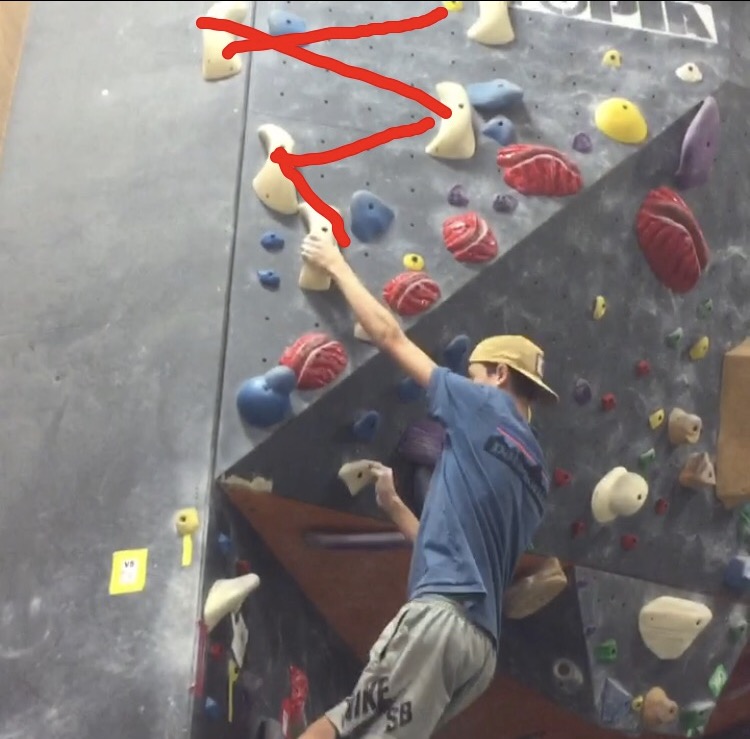
Before any climb that you do, you should try to visualize the route that you are about to ascend. This helps you when you are on the wall, and are searching for a hold. If you already visualized the route, you would know where to place your foot. Any time you are trying a new climb, always, always, always visualize your route. "Visualization is an immensely powerful tool that can be used to enhance performance in all aspects of your life." (Hörst 43) Below are some pictures of how I visualized my route. 


Pre-Climb Ritual

Having a pre-climb ritual can enhance performance intensely. It is like a pilots pre-checklist, everything you need for your climb should be on this checklist. An example of a ritual could be, scoping the route, eating a snack and drinking water, and then checking your gear. It is not hard to make one, and it doesn't take that long either. So next time you are climbing make a pre-climb ritual and follow through with it.

Now that you have the tools that you need to mentally prepare yourself before climbs, go out and use it. It will improve your climbing, and give you the confidence that you need to climb at your best. Thank you for reading this article, good luck on your next climb!


Hörst, Eric J. Training for Climbing: The Definitive Guide to Improving Your Climbing Performance. Guilford, CT: Falcon, 2003. Print. 


Question: What would your pre-climb ritual be?